
|
Index...
|
In this new history of Caludon Castle several myths have been dispelled, most notably that of its destruction in the Civil War. The many new facts that have been uncovered serve as a more than adequate counterbalance to the unsubstantiated claims and interpretations that have clouded many previous accounts of Caludon and its 800 years of recorded history. it would also be appropriate, therefore, to consign once and for all another myth - that of St George and Caludon - to the box named 'Fiction'. it may seem unnecessary to remind the reader that St George, a soldier, possibly born in Cappadocia, Turkey, or Lydda in Palestine, and martyred in the persecutions of the emperors Diocletian and Maximilian in the year 303, had no connection with Caludon. [1] But so strong has the myth taken root since the medieval English crusaders returned home inspired in their battles by the rapidly growing myth and popularity of St George that even recent local newspaper articles and numerous websites treat the story uncritically, even as fact. This despite the clear assertion in the 1969 Coventry volume of the Victoria County History that, 'The story easiest to reject is that the house [Caludon] was the birthplace of St. George.' [2]
It can be stated, therefore, without any doubt, or fear of future evidence coming to light, that St George was neither born at Caludon nor did he return there to die. All other parts of the Caludon version of the story, a later elaboration, are equally fictitious: the naming of his father as Albert, giving him the title of Lord of Caludon in King Arthur's time - and his mother's death in giving birth to George. After being kidnapped by a witch and brought up by her as a fearless knight, George apparently left England for many adventures abroad, returning when he heard that a dragon was terrorising Coventry, his lair a cavern hidden under Hill Top! George managed to slay the dragon but eventually died from the wounds sustained in the combat and was taken to Caludon, where he died.
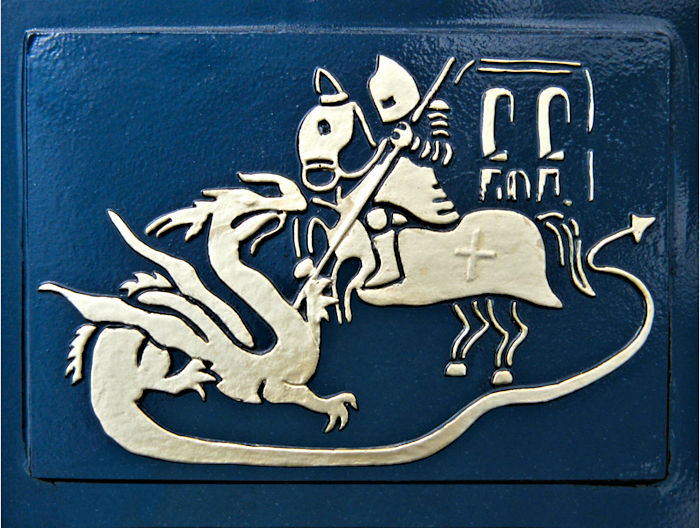
What is of interest is how an early fourth-century martyr, transposed to England, becoming its patron saint in the reign of Edward II (1327-1377) and obtaining a suit of medieval armour in the process, came to be specifically connected with Caludon Castle. The saint was already a figure of veneration and cult worship in many parts of medieval Europe and Asia Minor. The kernel of the story appeared capable of being fantastically elaborated and given a local flavour. The importance of late medieval Coventry probably played a significant role. Mummers or travelling actors would have been attracted to the bustling town and one of their favourite performances involved the exploits of St George. A script adapted to the locality would clearly have been even more popular.
Coventry was nationally known for its medieval cycle of 'mystery' or sacred plays, giving ample opportunity to weave in the legend of St George, his feast day (23rd April) an important early date in the festival calendar. [3] Many of the guilds owned processional carts, which were brought out on such days from the 'pageant houses' where they were kept, the vehicles used as stages for performances.
The Shearman and Taylor's guild had a chapel adjacent to Gosford Gate dedicated to St George, finally demolished in 1822 after having been used for many years as living accommodation. The local story of St George as briefly summarised above was given its final shape in the publication of The Seven Champions of Christendom by Richard Johnson (fl. 1592-1622). [4]
It was published in two parts in 1596 and 1597, the first part dedicated to Lord Thomas Howard, the 1st earl of Suffolk, hero of victory over the Spanish Armada and the raid on Cadiz (1597). He was nephew of Katherine Howard, wife of Henry Berkeley, whose colourful and extravagant life has been described in Chapters 3 and 4. Caludon Castle was at its epicentre, a destination for troupes of actors, singers and musicians in constant demand to entertain the Berkeleys and their guests.
Calling on the already well-established and extensive Coventry repertoire of sacred and mythical stories, it is possible the St George legend was given an extra local dimension when it was enacted at Caludon, perhaps staged by or witnessed by Richard Johnson. The performance may have delighted the Berkeleys and perhaps their Howard relatives, who encouraged and supported its subsequent publication.
NOTES:
1 Michael Walsh, A New Dictionary of Saints East and West, (2007) 224
2 VCH Warwick, Vol 8, 121
3 VCH Warwick, Vol 8, 211-215
4 Dictionary of National Biography
Hidden in a public park on the outskirts of Coventry is a remarkable fragment of history - an 8-foot-thick sandstone wall, with red sandstone decorative inlay - a remnant of a medieval building. Neglected for centuries, little was known about this ruin. Urban myth suggests that it was part of a great castle, destroyed in the Civil War, and the resting place of St George, who was mortally wounded saving Coventry from the dragon. But the reality is quite different: this was once a grand manor house owned by some of England's most illustrious families; but it fell into decline when the money ran out. This is the story of the rise and fall of Caludon Castle, and how a local boy with a life-long passion for history put it back on the map.
To celebrate Midsummer Night we are sharing this short video about the links between Shakespeare and Caludon Castle in Coventry - particularly the origins of A Midsummer Night's Dream, written during Lord Henry and Lady Katherine Berkeley's tenure at Caludon.
Lady Katherine Berkeley was laid to rest on 20th May 1596 in St Michael's Church, now old Coventry Cathedral. Her funeral procession was a quarter of a mile long and there was enough food at her wake to feed a thousand people just from the leftovers. But who was Lady Katherine, and why was she buried in Coventry?
The second in a new podcast series where Mark Ellis of Postmaster Media interviews people who are passionate about local history, and have felt motivated to do something about it - write a book, make a film, create an event, set up a society, etc. We find out more about what they've done, where that passion comes from, and why they have focused their attention on that specific area of local history.
John Clarke was born in the Wyken suburb of Coventry, a stone's throw from the ruins of Caludon Castle, a medieval fortified manor whose history was shrouded in mystery. John has dedicated much of his life to discovering the lost history of Caludon Castle, then sharing this through an acclaimed book and documentary film.

Website by Rob Orland © 2002 to 2026

