
|
Index...
|
From the book: 'Some Ancient English Homes & Their Associations Personal, Archaeological & Historic', Chapter V
THE battered remains of this ancient castle lie in the heart of Warwickshire, about three miles north-east of Coventry, and between it and Combe Abbey, the beautiful seat of the Earl of Craven.
At the Conquest Caludon came into the possession of the Earls of Chester, descendants of the famous Lady Godiva, whose memory is still cherished in the ancient city; the last of the Chesters giving it to Stephen de Segrave, a Baron and Chief Justice of England, in whose family it continued as long as the male line lasted.
The estate of Caludon does not seem to have been extensive, comprising only some 200 acres of land, with a park of 20 acres, a pool, and two watermills. Nothing is said of a house; but as the "one freeholder, John de la Hay," must have had some roof-tree, it is probable that he built the first dwelling erected on or near the site of the castle. In Henry III.'s reign the property was forfeited to the Crown, but regained on payment of a fine. An immediate descendant of Stephen, Gilbert de Segrave, married the heiress of the Chaucumbs, from whom comes the "lion rampant" of the Berkeley arms. His son Nicholas obtained a "charter of free warren," i.e., control of the smaller game, such as hares, rabbits, pheasants, &c. He was succeeded by John de Segrave, who seems to have decided to make the place his home, for in 1305 he "obtained license from Edward I. to build a house at Caludon with moat and embattled walls; this he afterwards enlarged, his son further extending the buildings and park, and building or rebuilding the chapel." Another John, grandson of the former and last of the line, married the Duchess of Norfolk; and their daughter, in default of a son, carried the hereditary rank of Marshal of England. This daughter married Thomas de Mowbray, a powerful and wealthy Baron of Arholme, Lincolnshire, upon whom consequently devolved the barony of Segrave, and who brings us to the incident in the family record, which, although issuing so tragically to themselves, helped not a little towards the betterment of their native land - an incident vividly chronicled by Hall, and which, in "Richard II.," inspired the graphic pen of the prince of play writers.
Thomas Mowbray, Duke of Norfolk, son and successor of the great Baron of Arholme, accused Henry Duke of Lancaster (afterwards Henry IV.) of treasonable speech against King Richard. Henry denied the charge, and challenged Mowbray to single combat ; and the king, failing to make peace, commanded them to meet in his presence, near to Mowbray's Castle of Caludon, and decide the quarrel by force of arms. Accordingly, in the autumn of 1397, the lists were set with royal splendour upon Gosford Green, between Caludon and Coventry - the spot is still shown. The King having arrived, and being seated on his throne beneath the royal pavilion, the combatants entered the lists fully armed, their horses and themselves resplendent in their respective colours; Mowbray in crimson velvet, embroidered in silver with the mulberry-tree and lion rampant; Henry, arrayed in blue and green embroidered with swans and antelopes of "goldsmith's work." Having professed the justness of their quarrel, and taken leave of king and courtiers, the marshal at the king's command bade, "Sound trumpets, and set forward combatants." Both sprang to horse, Henry riding impatiently forward, spear in rest; but scarcely had Mowbray advanced a pace when Richard, the weak and vacillating, threw down his gauntlet as a signal for them to stop. The heralds shouted a restraining "Ho! ho!" and, advancing at the king's command, took the spears from the hands of the astonished combatants and bade them dismount and retire to their respective tents. There they sat on their gorgeous chairs of state for two weary hours, while Richard and the council he had hastily summoned came to the decision familiar to every reader of history, and on which, although they little thought it, hung the fate of king and kingdom; the decision condemning Mowbray to banishment for life, and Hereford for ten years - afterwards commuted to six. Long ere that time had elapsed Henry had returned to wear the crown which Richard had so deservedly forfeited; but Mowbray, after wandering remorseful and desolate for several weary years, "died of melancholy." He left three children John, his successor; Isabel, married to James 1st, Lord Berkeley (this was the Princely Lady Isabel," who died a prisoner in Gloucester); and Margaret, married to Lord Howard, Earl of Surrey.
John was shortly succeeded by his son John, who had one little daughter; Anne, married, before her seventh year, to Richard, Duke of York, the younger of the two hapless lads murdered in the Tower. The poor little Duchess did not long enjoy her dignity; dying, according to Stowe, the very day after her marriage, and her immense estates finally passed to the Howards and Berkeleys; William, Marquis Berkeley, inheriting half the vast property, including Caludon, in right of his mother, the Lady Isabel. Although owning, he did not enter into personal possession, as John de Mowbray had leased the castle and land for life to Sir Humphry Talbot.
Maurice, brother and successor to Lord William, was the first Berkeley to live at Caludon; he did not spend much of his time there, however, but entailed it upon his wife (another Lady Isabel) and children, and she, after his death, lived and died there. On Lord Maurice's first visit, the abbot of the neighbouring monastery of Combe incurred his displeasure by not entertaining and honouring him as became the heir of the founder of the monastery, and as he had honoured the other heir, Thomas Howard, Earl of Surrey. Lord Maurice, therefore, filed a bill in Chancery to prove his descent and compel the abbot to entertain him as a "founder" and treat him with due reverence. The case was decided in his favour, and his posterity were thenceforth received with due homage; as is evidenced by the respect paid to the remains of the Lady Isabel when they were conveyed to their last resting-place beside her beloved husband in the church of the Augustine Friars in London. An account of the funeral ceremonies then observed has been left by Thomas Try, of Caludon, her relative and faithful administrator, and is well worth recording, as showing how a noble lady of those times was borne to her last resting-place.
From the Wednesday of her death until the following Monday she was watched continually with prayer and the chanting of psalms, one company of priests succeeding another, while the bells of Coventry Priory and churches, and of the neighbouring monastery of Combe, kept up a doleful clang. On Sunday, her "horse-litter" having been provided, she was placed thereon, and the procession set forth. First, thirty women of her household in black gowns and kerchiefs upon their heads, one ell each, with raw edges to show they were cut out of new cloth, every woman bearing a wax taper of 1lb. weight. After them followed twenty-six "crafts" with two hundred torches; about her hearse were her own servants, thirty-six, robed in black, and carrying waxen torches. Next after the crafts came the friars, white and grey, with their crosses the priests, to the number of one hundred, likewise with crosses, preceded the hearse, and behind it walked five gentlewomen mourners. After them came the Recorder, and proxies for the family; then the Mayor of Coventry, with Alderman, Sheriffs, Chamberlains, &c. "And so she was conveyed to the Mother Church (the Priory of Coventry), where she rested in the quire before the high altar all that night, and had a solemn derge; and the Maire and his brethren went to Sir Michael's, where was a derge in like manner. And after derge they went into St. Mary's Hall, where a drynking was made for them; first, cakys, comfetts, and ale, the second course, marmelet, snoket (sweets?), redd wyne and claret, and the third course, wafers and blanch powder with romney and muskadele; and," adds the careful steward, "I thanke God, nor plate nor spones was lost, yet there was XXti desyn spones." On the following morning, after mass, they again set forward in the same order, except that the five lady mourners rode on horses draped with black, the gentlemen also rode in like manner. At Binley Bridge they were met by "my lord the Abbot of Combe with his mitre, censing the hearse, and with him a great company, numbering five or six thousand." And then there was more feasting, "the bordes being set divers times," before the company separated, and the funeral cavalcade proceeded on its way. Verily, the committing of "earth to earth" must have been a costly process in those days!
Maurice 4th, Lord Berkeley, having no family, and spending much of his life abroad, let Caludon on lease for life to the afore-mentioned Thomas Try, a descendant of the Berkeleys, and a most faithful friend and counsellor. He afterwards granted twelve years' extension of the lease, to date from the death of Try, in recognition of his services to him while abroad. Lord Thomas 5th (of Yate and Mangotsfield), "from his great love to Gloucestershire," had determined at one time to exchange Caludon and his manors in other shires for property in the latter county, but was dissuaded by the earnest representations of Try from thus sacrificing the ancient baronies of Segrave and Mowbray, from which his family took their titles.
Caludon was part of the jointure of Lady Anne Berkeley, and immediately upon the death of Try, she went to take possession, ignoring the extended lease; but was kept out by Try's widow and her son. declared the lease forged, and had recourse to her usual argument a bill in Chancery; which, after two years, was, by influence and misrepresentation, decided in her favour. During the interval she made frequent attempts to obtain forcible possession; once filling up part of the moat with faggots to effect an entrance, and in the scrimmages both sides suffered considerably. She also claimed as part of the manor a house and lands in Binley, near by, which Try had bought and left to his illegitimate son, Gerrard; and upon the latter remonstrating and showing his deeds, she threatened to make him "burn a faggot" (he was a Protestant) if he troubled her any more. This Gerrard subsequently became a priest, and so effectually assailed Lord Henry, Anne's son, with importunities and texts of Scripture, as to procure 40s. a year, and a sum down in lieu of his land.
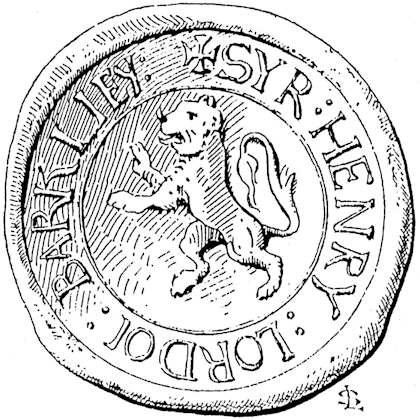
At this time, 3rd of Mary, 1556, Cardinal Pole granted to Lord Henry, the successor of Thomas 6th, permission to "use his chapel in Caludon as his ancestors had done before the schism, and to have a portable altar, to say mass and to receive the body and blood of Christ, and to keep the same in a box covered with a faire linen cloth, with a candle burning Before it;" and at the same time granted him the tithes before obtained from Pope Gregory, but which were lost at the schism. It is most probable, however, that in suing for this grant, Lord Henry was influenced more by the wishes of his mother and wife than by his own, as he appears to have leant to the reformed religion; for we find him, some years afterwards, availing himself of one of the long sojourns he and his family occasionally made with friends and relatives, to shake off the Popish hangers-on of his wife, because they were not conformable to his tenets in religion.

Lord Henry seems to have had a great liking for Caludon, for from the death of his mother in 1564, he lived almost entirely there, making only occasional sojourns at Berkeley and Yate. Probably the facilities for hunting and hawking which Warwickshire and the adjoining counties at that time afforded were one great attraction, both he and his wife, Lady Katherine, being such ardent devotees of the chase. They had no sooner settled at Caludon than they sent for their buckhounds from Yate, and began a progress of buckhunting in the neighbouring parks of Berkeswell, Bradgate, Groby, Leicester Forest, Ashby, and Kenilworth.
The Earl of Leicester, the owner of the latter, having, as we have seen, an eye to sundry properties of Lord Henry's, which he claimed as heir to the Lisles, professed great friendship for him, and invited him to Kenilworth to hunt as much as he listed; lodging him in his own chamber as a brother and fellow-huntsman. Then, having secured the goodwill of his guest, whose open, honest nature was slow to suspect deceit in others, he deftly introduced the subject of pedigrees, saying he counted it an honour to be descended from his guest's noble house, and should much like to know the particulars of the connection. Whereupon Lord Henry courteously permitted him to send a herald to Caludon and Berkeley to search certain deeds; which kindness the dishonourable and rapacious earl returned by abstracting many of them and using them to contest the possession of Wotton and other valuable estates. Indeed, the unsettled and involved tenure by which Lord Henry held his property, together with the litigious and overbearing dispositions of his mother and wife, involved him in continual lawsuits; and as he had neither the legal acumen nor the learning of his progenitors, the Lords Maurice Berkeley, he lost heavily. Sir James Harris, Serjeant-at-Law in King James's reign, facetiously observed that "the Berkeleys had with their longe walking beaten smooth the pavement between Temple-barre and Westminster Hall!"
Some of Lord Henry's lawsuits, however, had their comic side; as that in which he brought an action against Cyprian Wood, the groom of his wife's chamber, to recover certain moneys which the Lady Katherine had given him to disburse shortly before her death; Lord Henry bringing the man to account, not so much for the sake of the money, as because it had come to his ears that Wood (acting for one of the gentlewomen of the household) had attempted to steal a quantity of his fine linen. The said linen, with other valuables, had been packed, presumably by the gentlewoman," in two trunks, which it was arranged were to be ferried over the moat, in one of the brewhouse coolers, under cover of the darkness. The trunks had been safely conveyed to the bank and got aboard, but scarcely had the steersman pushed off two yards from shore when the bung-hole in the midst fell open, and the impromptu ferry-boat, being heavily laden, began to sink! Dire was the consternation; diverted, not lessened, by a sudden shout, as several of Lord Henry's retainers, who had got wind of the plot and set themselves to watch, sprang from their concealment, and, rushing upon the scene, succeeded by dexterous exertions in rescuing the precious linen and restoring it to its rightful owner.
Lord Henry's suits, however, were not always in defence of his own property. He seems to have taken a kindly interest in the affairs of his tenants and poorer neighbours, not unfrequently intervening to save them from the exactions and encroachments of rapacious land-holders. Which regard for justice, so unusual in those days, together with his boundless hospitality, and candid, generous nature, won him a warm place in the hearts of the common people. Indeed, this lord, in spite of his too great love of amusement (and "His longe, slender, lady-like hand knew a dye as well and how to handle it as any of his rank and time") was a right good and honourable gentleman - the most upright in character and generous in nature of all the ancient lords of Berkeley.
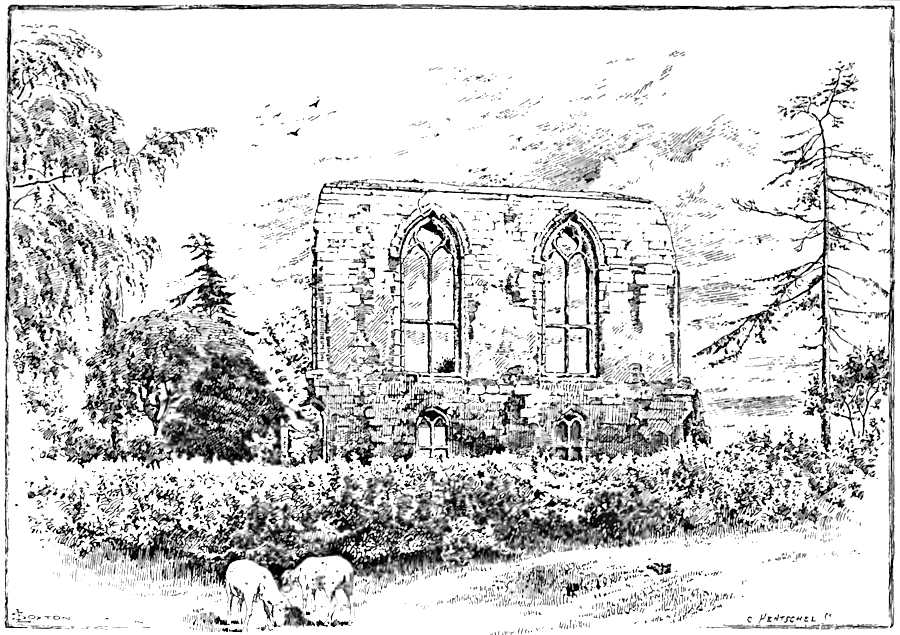
Caludon Castle under Lord Henry was a large and imposing mansion; much more imposing and extensive, as indeed was the manor itself, than it was under his predecessors. Fortunately, Smyth gives some account of the additions and rebuildings, which will enable us to form a fairly accurate idea of its size. and general appearance in this lord's time.
He says: "About the 22nd of Elizabeth (1580) was the porter's. lodge, the buildings towards the great pool on the north-western part of Caludon House, with the brewing house, the stables, and many other outhouses, both within and without the moat, built of new; and the roofs of those old castle buildings taken down and so altered that the whole house might be said to have been moulded and made new. But for the banqueting house on the north side of the said pool, it was the polite work of the Lady Elizabeth, wife of Sir Thomas Berkeley, in the 40th and 41st years of Elizabeth, and the retired cell of her soul's soliloquies to God her Creator."
Thus it will be seen that a practically new mansion was erected; of which, alas! owing to the destructive havoc of the Civil Wars, only one solitary wall now exists. The general plan of the castle remained the same as when first designed by John de Segrave; that is an oval, of little more than an acre in extent, lying east and west. This was surrounded by a moat and strong embattled walls, and within stood the various buildings; the entrance being by a gateway and drawbridge on the east. No trace of this is to be seen, however, the moat having been filled in on that side; on the other three it is perfect, though now dry and turfed. The principal apartments of the castle lay on the north and west of the courtyard; viz., the great chamber or banqueting hall, the hall where the yeomen dined and lived, the dining-room, withdrawing-room or lady's chamber, chapel, great gallery (used for audiences and for exercise in bad weather), sleeping apartments, &c. The kitchen, brewhouse, bakery, and other offices occupied the south and east sides, the stables being near the entrance, as was usual; although on account of the confined space, some of these must have stood without the moat with the other farm buildings on the east and north, where is now Slaughter-house Close," an old timbered barn, and other traces. The chief entrance to these ancient castles was invariably through the farmyard. The bowling green is still clearly traceable about 250 yards south of the moat, the gardens most probably occupying the intervening space. The "Great Pool" is now a fertile field of about three acres in extent, called "The Pools," and still keeps its ancient shape.
The household of Caludon, even when, through losses and lawsuits, Lord Henry's fortunes were at their lowest ebb, never numbered less than seventy persons viz., the "gentlemen," under the gentleman usher, who was expected to keep order and regulate the household; to see that all attended service in the great hall or chapel, and to meet and, with the gentlemen, entertain all strangers of worth. The yeoman usher; usher of the hall; yeoman of the great chamber, with the yeomen under them, whose duty it was to prepare and keep in order the dining chamber, to strew with rushes, dust cushions, remove spots from carpets, chairs, stools, &c.; to cheer with fire in winter and flowers in summer, and one or both of whom was to be always in attendance to remove seats, snuff candles, and light gentlemen guests to their chambers; also "to suffer no doggs to come into the dyneing chamber." The yeomen had also to attend the lady when she rode abroad; the "gentlemen" performing like service to the lord. Then there were gentlewomen, maidservants, and servants of the kitchen; cooks, bakers, brewers, &c.; besides grooms, smiths, huntsmen, falconers, and men-at-arms; with also a resident priest, secretaries, and steward; and several youths and maidens of gentle birth, attendants and companions of the younger members of the family. It was in this capacity that Smyth himself entered the service of the Berkeleys when a lad of seventeen.
During his earlier years few contemporaries outshone Lord Henry in the magnificence of his style of living and the number of his retainers, to which extravagances He was incited by his high-born wife. The following is her portrait, sketched by the compiler of the Chronicles; The Lady Katherine was tall, with yellow hair and a lovely complexion, of haughty carriage and bearing, though gracious to her inferiors, and very eloquent of speech; but she ruled her husband too much and not wisely, helping herself from the proceeds of all that was sold without his knowledge." He (the chronicler) gives an amusing instance of her haughtiness."
Soon after entering her service, and while the family were living at the White Friars, Coventry, which had been taken on a three years' lease, he was passing her hurriedly in the corridor with a covered dish for her son's breakfast, and, in place of the customary elaborate salutation, made only a "running legg," or courtesy. She immediately called him back and ordered him to make a hundred "leggs." Then, seeing he did it awkwardly, being a novice in the art, she gave him a lesson, raising her own dress nearly to the knee, that he might see the exact angle at which to bend, and the graceful sweep of the foot! The same author has a story of how this high-born lady, in her desire to pry into futurity, wrote a letter to an old wizard in the Forest of Arden, and how the letter fell into wrong hands and liked to have caused grave scandal. But he tells also how sweet a singer she was, and how her husband and the ladies of her household would stand outside her chamber door to listen while she sang, accompanying herself upon the lute.
Once, to please her haughty fancy, Lord Henry outbid Queen Elizabeth for a mother-o'-pearl lute upon which both ladies had set their minds. The price was so heavy that he agreed to pay it by instalments; but ceasing to carry out his agreement, he was finally sued for the remainder! Ten years after Katherine's death Lord Henry gave this lute to the Countess of Derby; in 1810 it had come into the possession of Mrs. Jordan, the actress. In addition to her musical talent, Lady Katherine was, also, a good linguist, and learned withal; in later life giving herself to the study of natural philosophy, astronomy, mathematics, and other abstruse sciences.
Interesting and valuable indeed are the glimpses given of the owners of this stately mansion, and the life lived there in those far-off times. Their chronicler tells, for instance, of Lord Henry's religious exercises, how regular and devout he was at public and private devotions; describing how his own duty was, as a youthful page of the household, so soon as his lord was up and dressed, to carry his cushion and book to his chamber; and how, as he waited without to bear them away again, he had heard him pleading audibly, "for mercy and forgiveness." To his servants Lord Henry was kind and liberal: too much so, for many of them seem to have been arrant wasters and time-servers; while he did not forget the poor at his gate. On three days of the week "the poor of the villages and parishes next adjoining Caludon came for relief, each receiving a mess of wholesome pottage with a piece of beoffe or mutton therein; half a cheat (wheaten) loafe, and a kan of beere; while he daily carried in his purse, for private distribution, 8s. or 10s. in small sums. On Maundy Thursday many poor men and women were clothed by this lord and his wife; and at the three great feasts, Christmas, Easter, and Whitsun, a sum of 20 marks was sent by him to several of the chief inhabitants of those villages, and of Gosford Street, Coventry, to be distributed."
As showing how kindly and perfect a gentleman Lord Henry was, Smyth says: At Christmas and other festivals when his neighbours were feasted in his hall, he would, in the midst of their dinner, rise from his own, and, going to each of their tables, cheerfully bid them welcome; and when guests of honour and high rank filled his own table, he seated himself at the lower end; and when such guests filled but half his board and those of meaner degree the other half, he would take his own seat between them in the midst of his long table near the salt, which gracious considerate acts did much to gain the love that his people had for him" - Far more than they had for his haughty wife, Lady Katherine, high-born and beautiful, and clever though she was. Indeed, one could never imagine her as sitting "below the salt," out of consideration for the feelings of an inferior. She seems to have claimed and enforced royal homage; even her prayerbook must be presented with the lowest courtesy and on the knees of her gentlewoman; and she never forgave those who had slighted her or detracted from her power and state. Much of the trouble that befel herself and family through the continual lawsuits with the powerful Earls of Warwick and Leicester, might have been averted had she not pressed and harried her too yielding husband into contesting their claims, instead of, as wisely advised, letting the lands go by default. She also obstinately refused the offer of a double marriage between her two daughters and Sir Philip and Sir Robert Sydney, nephews and heirs of the Earl of Leicester: which marriage would have healed the feud, and, as Smyth truly says, have given her daughters for their husbands "two of as eminent gentlemen as England afforded."
Her haughty spirit and resolute will, however, stood her in good stead at times; as in the following instance. About three years before her death, suffering much pain in one of her fingers, she was told by "an excellent chirurgion of Coventry" that either it must be cut off close to the palm, or else be lanced all along to the bone. She chose the latter, although far more painful; and when he desired one of her strongest gentlewomen to hold her, as the pain would be extreme, she refused, saying, "Spare not you in performing your part, and leave the rest to me." Then, "holding out her hand, he did his office, she never blenched nor appeared even to notice the pain. At which the surgeon seemed incredibly to wonder" - as well he might!
Early in Elizabeth's reign a son had been born to Lord and Lady Henry, but he died in his second year; several daughters followed, two only arriving at maturity. That the male line should thus die out was a great trial to Lady Katherine, and she confided her trouble to Mr. Francis Aylworth, of Kington Magna, Warwickshire, "a little old weirish man, but an excellent well-read chirurgion and physician, and for many years a gentleman living in her house." He cheered her by prophesying that within a year she would have a son and heir, offering to wage ten pounds to thirty that so it would be. The lady accepted the wager, willing enough to lose if the prophecy came true. It did come true, and when assured by her attendants that she was the mother of a son, her first words were, "'Carry Aylworth his thirty pounds,' which she had purposely laid ready in gold in her chamber."
This son, born 1575, was named Thomas; Queen Elizabeth, then staying at Kenilworth, being his godmother, the Countess of Warwick acting as proxy. The "most part of his education was at Caludon, under the indulgent instruction of his mother and her gentlewomen, whom, in nine years, they had only taught to spell and meanly read a little English." At that time the family entered on their three years' residence at the White Friars, Coventry, where the young heir was provided with a tutor, and two youths as attendants and fellow-scholars - Smyth himself, and William Ligon, a descendant of the Berkeleys. After two years the lads, with their tutor, went for three years to Magdalen College, Oxford; where Thomas Berkeley fell ill of a fever, from the effects of which he never wholly recovered. Coming up to London with his father at Michaelmas term, 1594, to a lodging in Fleet Street, he first met Elizabeth Carey, only child of Sir George Carey (afterwards Lord Hundson), then living at his house in the Black Friars, to which lady he was married in the following February.
When Queen Elizabeth died, this Thomas Berkeley accompanied his brother-in-law, Lord Carey, to Scotland to carry the news to King James. At the coronation he was created Knight of the Bath, and on the assembling of Parliament, was one of the representatives of Gloucestershire; for the rest, he seems to have been weak in health, selfish and extravagant. He died at Caludon in his thirty-seventh year, and was buried "in the north-east corner of St. Michael's Church," his widow erecting to his memory the tomb of grey marble; since removed lower down the aisle near to the north door.
In that same north-east corner of St. Michael's, then the Draper's Chapel, now the Lady Chapel, his mother, Lady Katherine, had been laid to rest some fourteen years before, "with the greatest state and honour that for many years past had been seen in that city or in those parts of the kingdom." Her monument, of black marble, has been destroyed.
The account of her interment, although too long to give, is interesting and suggestive when compared with that of the Lady Isabel, as showing the change in funeral observances from those prevailing in the pre-Reformation days of Henry VIII.
In the later as in the earlier time, the corpse was watched with prayer and psalm day and night (in this instance for six weeks); and when at length removed to Coventry for interment, a train of mourners a quarter of a mile long, clad in all the orthodox habiliments of woe, and marshalled according to their rank, escorted it to the church. Bells clanged dismally from neighbouring steeples, and crowds of curious sightseers lined the narrow streets; but priest and monk, gilded cross and waxen candle, that had made such a show in the old days, were conspicuously absent. His "Lordship's Chaplins," of course, were there, to perform the ceremony and preach the sermon; but instead of the company of priests, and friars, white and grey, walked with marshal steps and stately bearing a train of knights and gentlemen, carrying aloft the "banner of honour," banner-rolls, and escutcheons, great and small, blazoned with the titles and dignities of the lady's noble house. While marshalling the long procession was no less a person than "Mr. Garter" in his "kingly coate of arms,' assisted by "Chester Herald," and "Marshall Denis." As has been well said, "The heralds' visitation commenced when the doom of the monasteries was sealed."
Lord Henry was not present at the ceremony, having remained "mourning in his chamber at Caludon." To which place, after all was over, the funeral train returned and were entertained in such liberal and sumptuous fashion that the dishes left over which had been scarcely touched, served to feast more than one thousand poor persons. The noble mourner, however, did not long remain disconsolate, marrying in the following year a widow of mature age, daughter of Sir Michael Stanhope; though why he did so sorely puzzled his chronicler, for the two seem never to have lived together, nor to have shared each other's goods or interests; the lady residing at her mansion in London, Lord Henry, for the most part, at Caludon. Here, in 1603, after a fortnight's illness (caused, it is said, by a surfeit of small custards!) he passed quietly and peacefully away; "letting fall his fatal anchor that never can bee wayed up." He was buried in his own chapel at Berkeley, the funeral train being met at Tetbury by a great company of tenants, who attended it to Berkeley with real tears and lamentations for the "loss of the best landlord England had, whose like might not after bee by them expected."
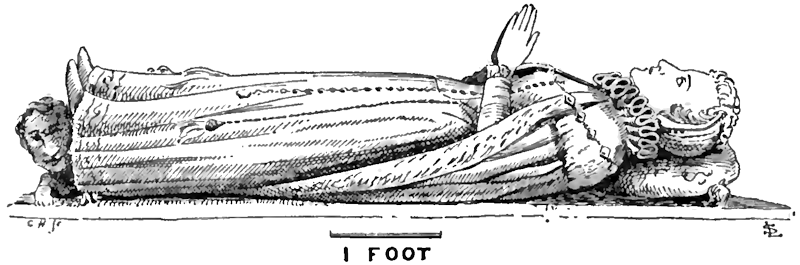
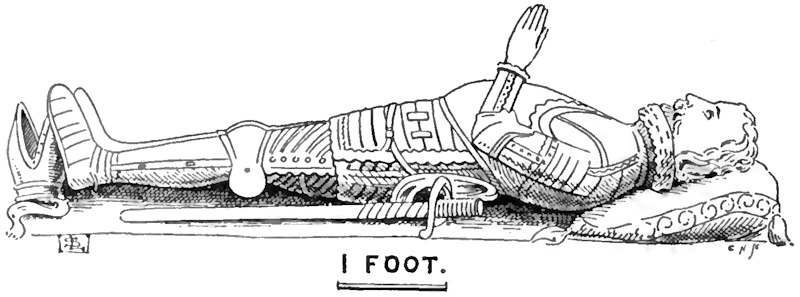
Upon the tomb of white marble that covers his remains are beautifully executed effigies of himself and Lady Katherine; of which Smyth, who, from his personal knowledge, was well qualified to judge, says, "The resemblances of both Henry and Katherine are to the life." The reproductions given of these interesting effigies are from sketches by Mrs. Bagnall-Oakeley, to whose clever and artistic pencil archaeologists are much indebted.
Lord Henry was succeeded by his grandson George, then a boy of twelve, who, with his sister Theophilia, were the only surviving children of Sir Thomas and Lady Elizabeth Berkeley.
The first part of his childhood was passed sojourning with his parents at various mansions, finally settling at Caludon, where he attended school at Coventry under Dr. Philemon Hammond (the first translator of "Camden's Britannia") until his grandfather's death, when he removed with his mother and sister to London. Here, and at Lady Elizabeth's various mansions in the neighbourhood, he remained, under the instruction of a tutor, until ready for Oxford. Long before then, however, ere he had completed his fourteenth year, a marriage had been arranged and consummated, by the exertions of his mother and grandmother, between him and Elizabeth, daughter and co-heir of Sir Michael Stanhope, "she being of the age of nine years."
And here (1618) the chronicler, "having traced the history of this noble family through all its vicissitudes for 20 generations, extending over 550 years," ceases, leaving Lord George just entered upon his University career at Christ Church, Oxford.
From other sources, however, we gather that in 1632 Lord George sold his castle and manor of Caludon to Thomas Morgan, of Weston-upon-Weatherley, in the same county - a scion of the Berkeley stock, from whom, through failure of direct issue, it passed to Colonel Thomas Morgan, in whose time the castle was demolished, for this Col. Morgan was a Parliamentarian soldier of great repute. He commanded a regiment of dragoons under Fairfax; was some time Governor of Gloucester; took Hereford from the Royalists; served with Cromwell's Ironsides in the Netherlands; and finally assisted General Monk in the Restoration!
It is impossible to tell which party was responsible for the destruction of Caludon, or when it actually took place, as no account seems to be extant. Tradition says it was "besieged, the opposing force gathering at a place still called 'Campfield'"; but it is silent as to whether the "force" was composed of Royalists, or whether it was battered down by the Parliamentarians themselves lest it should be used against them when Charles laid siege to Coventry.
Whichever party did the work, however, they did it thoroughly; only a portion of one solitary wall, that of Lady Elizabeth's banqueting hall, being left. It is an outer wall, 4 feet thick, with four windows entire, two above and two below, and traces of others on either side; and as the portion remaining is 60 feet high and 36 feet long, the hall must have been a noble one. The top windows (those of the hall) are graceful examples of late Perpendicular; they are ogee-headed, the trefoil-headed lights being divided by mullion and transom, with an open quatrefoil above. The lower windows are much smaller, trefoiled and transomed likewise, but with round traceried arch, and deeply recessed inside. This, together with the remains of a fireplace (the chimney going straight up in the thickness of the wall) show that it was a living room, not a "cellar," as has been stated; and most probably the "retired cell" of Lady Elizabeth; the sleeping apartments of lord and lady being usually on the ground floor - as at Thornbury. Some years ago the remains of the chapel were visible west of the hall, but no traces now exist.
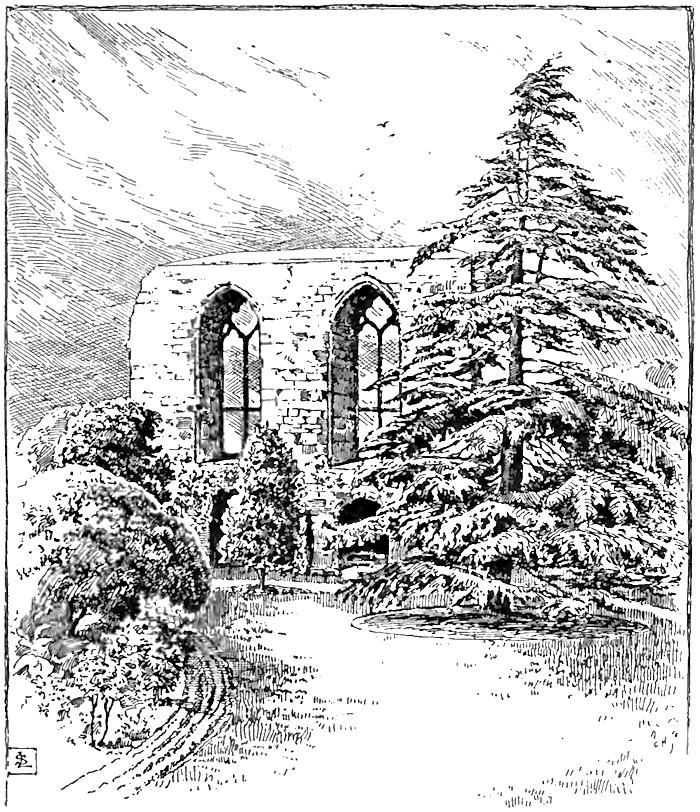
Local authorities have always considered this ruin as belonging to the original building. This, however, is clearly wrong; for, even apart from Smyth's account, the transomed windows would be sufficient to disprove it, as, with scarcely any exception, they were not used so early as John de Segrave's time. There is, however, equally little Elizabethan architecture in the fragment of building, Lady Berkeley evidently having the good taste to prefer the light and graceful Perpendicular to the heavier and more elaborate Tudor style. Most probably, also, she built to correspond with Lord Henry's renovations, the Perpendicular being much used at that time in restoration and rebuilding.
Colonel Morgan having no son, the property passed through his daughter's marriage, to Sir John Preston, of Furness, and from him to his brother Sir Thomas, who left two daughters, co-heiresses - one married to the Earl of Powis, the other to Lord Clifford of Chudleigh. On the partition of the property, Caludon fell to the latter, one of whose family in 1800 built the present farmhouse, "using much of the fallen stone." From the Cliffords it ultimately came to its present owners, the Rev. and Mrs. E. H. Garrard, of Marston Sicca, Warwickshire.
The old courtyard, once resounding to the tramp of hoofs, the sharp clink of armed heel, and all the busy preparations for the war or chase, is now a pleasant garden. Sweet white roses fling their graceful tapestry over the ruined wall; while in the deep recesses of the windows children play hide and seek; or perchance (for there are maidens in the old farmhouse) lovers whisper and protest, little witting the strange or stirring stories those ancient stones could tell.
NOTE: Recent research has narrowed down the demolition of Caludon Castle to some time between 1731 and 1748, and not during the Civil War as claimed in the text above. Please see John E. Clarke's excellent article on Caludon Castle for more information.
NOTE 2: The two illustrations above labelling the castle remains as being part of the Banqueting Hall are actually what we now know to have been the Great Chambers.
You may also wish to watch 44 minute in-depth documentary, available on YouTube.
Website by Rob Orland © 2002 to 2026

